AI in the home is not just a care story. It is a question about where Canada builds its next layer of health system capacity.
By Robert Stanley, CEO and Founder, CHAH AI Care and Stay at Home Nursing Care Services Kevin Jia, CEO and Co-Founder, Quoted Tech

Canada is about to run out of room. Not because we lack commitment, compassion, or clinical expertise, but because the architecture of care was built for a different era. We designed a healthcare system around episodic visits, institutional beds, and crisis response. But the next wave of need will be continuous, distributed, and largely outside institutional walls.
By 2030, nearly one in four Canadians will be over 65. Ontario alone projects 3.1 million adults living with major chronic illness by 2040. The pressure is already visible: roughly 72,000 people are currently waiting for long-term care in a province with approximately 80,000 existing long-term care beds. At the same time, Canada operates with just 2.5 hospital beds per 1,000 people, well below the OECD average of 4.2. These are not separate statistics. They are signals of the same structural problem: demand is moving faster than institutional capacity can expand.
We cannot build our way out of this with beds and buildings alone. The next layer of Canadian healthcare capacity will not be constructed only in a new hospital tower or a new long-term care wing. It will need to be built where risk actually develops: in the home.
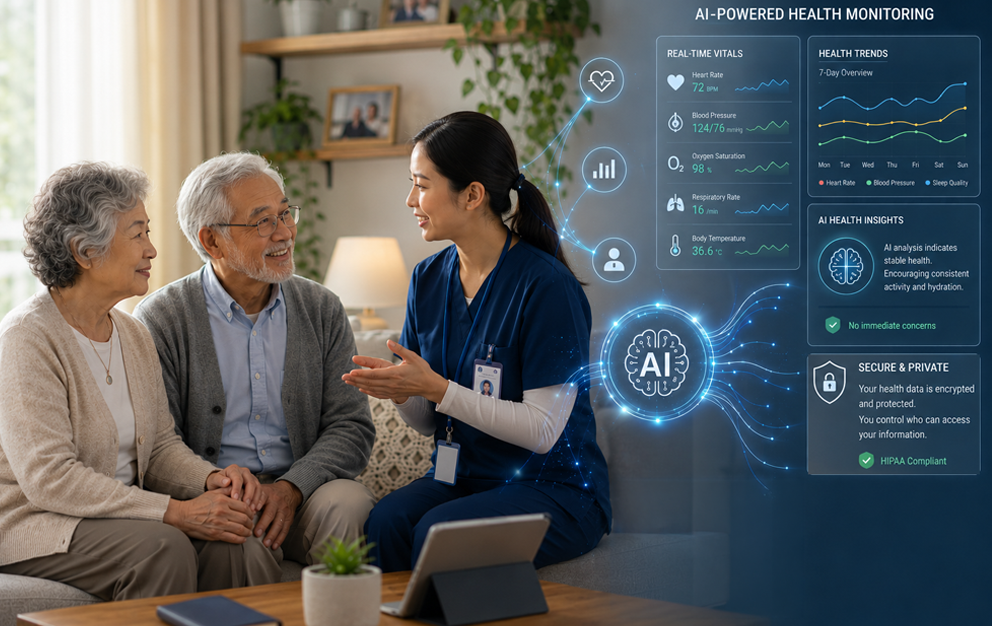
This is the problem CHAH AI Care and Quoted Tech are working to solve together. CHAH AI Care combines in-home monitoring, AI-supported risk detection, clinical triage, and human response through nursing and personal support worker teams in the home. Quoted Tech provides the Canadian-built computing infrastructure that allows that model to operate reliably inside a patient’s home. Together, the goal is not to replace human care, but to give care teams the visibility and response capacity to intervene before a manageable health change becomes a hospital event.
The system was designed for events, not for people
To understand why a home-based care layer matters, we have to look at what the current system is structurally unable to see.
Our system is funded by episodes, measured by encounters, and staffed for scheduled visits. What it does not do is watch what happens between those visits — and that is precisely where health deteriorates.
For someone living with complex needs, the risk does not pause when the care team leaves. Subtle gait changes may precede a fall. Increased bathroom frequency, temperature changes, or disrupted sleep may signal infection risk. Reduced movement, disrupted routines, or behavioural changes may indicate deterioration that a scheduled visit will not capture in time.
The system’s response to this structural gap has largely been informal: it has offloaded the monitoring function to family caregivers. Millions of Canadians now provide unpaid care — watching, worrying, and filling the space between professional visits with their own time, labour, and anxiety. This is not a care model. It is a coping mechanism built on top of a system that was never designed to see risk continuously.
When that informal layer fails, or when there is no family available to serve that function, the outcome is predictable. A preventable deterioration becomes a crisis. The crisis produces a hospitalization. The hospitalization frequently results in a transition to long-term care that could have been deferred — or avoided entirely — with earlier intervention. The forced transition is not always a clinical inevitability. It is often the consequence of a care system that can only see risk after it becomes a crisis.
The hard problem is infrastructure, not software
AI in healthcare is frequently discussed as if it were only software. In most contexts, that framing is adequate. But if the use case is continuous care delivered in the home — for people with complex needs, in non-technical environments, often without a caregiver present — then the hard problem is not the algorithm. It is the operating layer beneath it.
This is where the work of Quoted Tech becomes load-bearing.
Quoted Tech builds high-performance computing systems by hand in North York, Ontario. The hardware powering the CHAH AI Support Hub was designed around a single governing question: what does it mean to run healthcare-grade infrastructure inside someone’s living room?
The answer looks nothing like enterprise IT. The system has to process camera and sensor data locally, at the edge, because a cloud round-trip is too slow for decisions that matter at 3am. It has to run without interruption in a home where there is no IT department, no managed network, and no tolerance for a reboot. And it has to fail gracefully — because in this context, how the system fails is not a technical question. It is a clinical one.
If the home becomes a healthcare environment, then the infrastructure inside that home becomes part of the healthcare system. Where data is processed, who controls the hardware, and which jurisdiction governs its storage are not abstract policy questions. They are questions about who has access to some of the most sensitive personal information that exists. Building and deploying Canadian hardware running Canadian software means that data stays here — governed by Canadian law, managed by Canadian teams, and subject to Canadian standards.
That is not a nationalist argument. It is a clinical governance argument.
What changes when the system can see risk earlier
The evidence that early intervention changes outcomes is not theoretical. It is a function of time compression.
The difference between a managed health event and an emergency frequently comes down to hours. A urinary tract infection caught early is treated with oral antibiotics. Left undetected until it escalates to sepsis, it becomes a hospital admission of eight to ten days, with an 8.1 per cent mortality rate. A gait change detected before a fall can trigger an assessment, an environmental adjustment, a timely conversation with a clinician. A fall discovered after the fact frequently triggers an ambulance, a fracture protocol, and a transition pathway that begins in an emergency department and often ends somewhere other than home.
When the CHAH AI Support Hub detects a pattern that warrants attention — changes in gait, movement disruption, altered sleep, or behavioural shifts associated with cognitive decline — a clinical team receives a signal and a personal support worker can be dispatched in near real time. The technology surfaces the risk. Human beings respond to it.
This distinction matters. An alert without response capacity is not a care layer. It is only a notification. The failure of most monitoring tools is that they end at detection. CHAH’s model, combining detection and prediction, only works because the clinical response capacity exists on the other side of every alert.
This is not a pilot. It is already operating.
CHAH AI Care is live today with clients across the Greater Toronto Area. Advanced discussions are underway with publicly funded health programs on formal pilot deployments. The model is not waiting for permission to exist — it is operating in real homes, with real clinical teams, for people whose care needs do not fit neatly into a scheduled visit model.
What is still being built is the evidence base that will allow the model to scale into the broader health system — and that work is now formally underway.
CHAH AI Care is participating in an 18-month independent research evaluation led by McMaster University’s Institute for Research on Aging. This is not an internal study or a vendor-funded review. It is an independent academic evaluation designed to measure whether AI-enabled continuous monitoring and early intervention actually change outcomes at scale — tracking falls, infection escalation, avoidable emergency visits, hospitalizations, long-term care transitions, and the burden carried by family caregivers. The results will speak for themselves.
That kind of independent validation matters because the claim being made here is not modest. The claim is that a continuous, AI-enabled, home-based care layer — backed by reliable Canadian hardware and integrated with human clinical response — can reduce the pressure on a health system that is structurally running out of room. McMaster will tell us whether the numbers support that.
The choice ahead
The next capacity layer of Canadian healthcare is already being built. It will not look like another hospital tower or another long-term care wing. It will look like homes equipped with intelligent monitoring, Canadian-built computing, and clinical teams able to respond before risk becomes crisis.
The question for health systems, policymakers, and technology leaders is no longer whether care will move into the home. That is already happening, by necessity and by choice. The question is whether we build that clinical response layer deliberately — with the right hardware, the right data governance, the right human capacity, and the right commitment to reaching the people who need it most — or whether we arrive there only after the existing system has exhausted every other option.
Home is not a consolation prize. It is where health actually changes. And it is where the next layer of Canadian healthcare needs to be built.