Health is the mother of everything.
Hausa Proverb
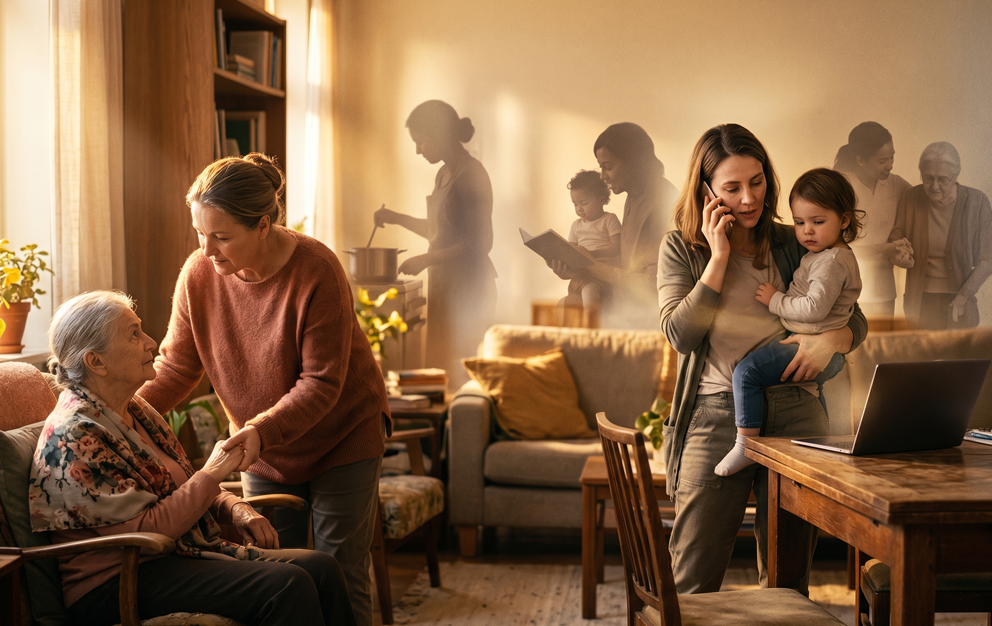
Recently we celebrated International Women’s Day, a day to advocate for the rights of women and girls around the world and to raise awareness of the many joys, and many challenges, of their lived experience. Since 1910, when advocate Clara Zetkin initiated the movement to create an International Women’s Day, the possibilities available to women have expanded and flourished. But what remains true is that women today—no matter how challenging their profession, or how great their accomplishments—are still predominantly tasked with providing the bulk of unpaid family caregiving. They often do so with love and significant skill, but very little tangible material support.
Yet they persist.
They know that health, and wellness, are the bedrock of a vital vibrant life—no matter what your age. And they know that health begins at home.
Women and girls undertake more than three-quarters of unpaid work care work in the world and make-up two-thirds of the paid care workforce. They carry out 12.5 billion hours of unpaid care work every day. When valued at minimum wage, this would represent a contribution to the global economy of at least $10.8 trillion a year, more than three times the size of the global tech industry.
Oxfam International
In Canada, our ability to care for our aging population rests heavily on these two groups of people—paid and unpaid caregivers. Paid caregivers, or Personal Support Workers, are the largest front-line workforce in Canadian healthcare and arguably the least visible. PSW’s help people bathe, eat, move, take medication, and live with dignity. The second is family caregivers, dedicated family members who are tackling these same challenges with aging family members, often while also being employed outside of the home and raising young children. The intense labor of family caregivers is largely invisible in policy discussion and doesn’t significantly figure into GDP calculations or healthcare budgets. Yet it is this feminine-associated commitment to care, and caregiving, that builds the foundation for a healthy society. Health, as the Hausa proverb goes, is the mother of everything.
The most profound determinants of wellness spring from social and political structures. In Canada, when it comes to healthcare, these structures are stuck in a state of arrested development that are incapable of addressing the current challenges of a rapidly aging demographic. The full vision of Tommy Douglas’ Medicare included support for home and long-term care but was never implemented, so despite impressive accomplishments, healthcare in Canada has never been universal in either coverage or accessibility.
According to Jane Philpott, former Minister of Heath, this state of arrested development has created a sickness—not a health—care system in Canada. Our healthcare system is one of the best in the world in addressing emergent, acute events; where it is failing every Canadian is in how it supports basic caregiving within the home and community. Canadians place high value on medical system cures, and rightfully so. However, we do not value care. In fact, in many instances we actively devalue it.
Care is as Important as Cure
During the worst phases of Covid, Canadians witnessed the horrifying results of a breakdown in care infrastructure in many of our long-term care facilities. Despite that brutal lesson, and despite the looming, exponentially growing pressures of an aging demographic on our healthcare system, Canada has yet to fully address the critical importance of investing in a robust and reliable caregiving infrastructure.
The first step begins by acknowledging the profound value of the work of paid, and unpaid, caregivers, in our communities. And not just for a single International Women’s Day, but year-round. For more details and concrete suggestions on how CHAH proposes to redesign the caregiving infrastructure please view: The Invisible Backbone.
Inequality in public health —i.e. optimal services for only the wealthiest or most well connected—creates a breeding ground for anger, distrust, and political division. But health at home—for all Canadians, no matter what your postal code—that is the foundation for a peaceful and productive society.
And a final quote truly captures the universality of this issue facing us all:
“There are only four kinds of people in the world: those who have been caregivers, those who are currently caregivers, those who will be caregivers, and those who will need caregivers,” Rosalynn Carter
Oxfam International, “Not All Gaps Are Created Equal: The True Value of Care Work”